Sunday, February 22, 2009

A great mystery!

This story takes place in contemporary Dublin, where a 12-year-old girl has been murdered; her body was found by archaologists - she was laid out on an ancient stone used for sacrifices centuries ago. In this same location about 20 years ago, three 12-year-old kids went into the woods and disappeared. Well, two of them did -- the third was found hours later with his arms wrapped around a tree, his shoes filled with blood. He has no memory of what happened. This boy became a policeman when he grew up, and he is one of the detectives trying to solve the crime of the current murder. Perhaps he'll also be able to find out what happened to his two friends, who were never found.
He realizes that he probably shouldn't even be connected to the case because of his personal involvement, but only his partner knows his story, and she leaves the decision up to him.
I'm only about halfway through this story, but I LOVE the mystery, the description of the characters and their relationships, and the just-slightly-different culture that is Dublin. And I'm being good - I haven't read the end of the book yet, and I'm trying really hard not to. I will update in a week or so when I finish, but so far, I would highly recommend this one.
Four stars
!

Wednesday, February 18, 2009

One false step, and BAM! there goes your future . . .

A videotape of a sexual encounter between three H.S. basketball players (ages 18 and 19) at a private boarding school in Vermont and a 14-year-old freshman finds it way to the headmaster -- and eventually to the parents, police, and the press. What happened to these three promising young men, two of whom had never been in trouble before? Did the girl "seduce" them, and in light of the law, does it even matter if she did? Shouldn't they just say no? This disturbing novel takes a look at the issue from multiple viewpoints, illustrated by interviews conducted two years after the event. If any of these boys could go back in time, you just know they would make a different decision -- but who among us can't say the same thing about various episodes in our own lives? Most of us are lucky, though, in that the consequences of our bad decisions don't affect us as drastically as they do the characters in this novel. This is a sad story - but utterly believable. It's hard not to point fingers at who was MOST responsible, who was hurt the most, who should pay the biggest price. The characters are multi-faceted and real, and the entire story just made me so grateful not to be in the middle of it. But it was still kind of sleazy, and therefore I can't give it all four starts.
So -- three out of four.

Tuesday, February 10, 2009

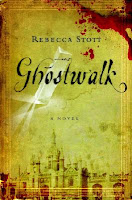
Ghostwalk: don't look behind you!

I know, I know, this is the wrong month for ghost stories, but this is the book selected by the teacher's book club for February. To appease those who insist on love stories for Valentine's Day, this is also a love story -- but not your ordinary kind. Writer Lydia Brooke agrees to complete the unfinished book after her ex-lover's mother dies unexpectedly. She moves into his mother Elizabeth's house and is soon enmeshed in research on the life and career of Sir Isaac Newton, the subject of the unfinished book. Sure enough, Lydia and the married Cameron soon resume their affair, but they both have many secrets. Cameron, a scientist who develops pharmaceuticals in a lab where they use rats for their trial experiments, is always in danger from an animal rights terrorist group -- but he doesn't tell Lydia about the true purpose of the drugs he's developing, nor of his involvement with a world-wide group pulling the strings. Lydia, conducting research on Trinity at Cambridge University in the 17th century, doesn't share information about the mysterious lights that appear in his mother's house, the odd disappearances, the man in a red cape she keeps seeing just out of the corner of her eye, nor the woman who approaches her to channel the spirits of contemporaries of Newton who died in unexplained ways.
The story takes meandering paths and leads Lydia into dangers she can neither foresee nor avoid. This is a book full of historical facts and scientific explanations -- but always with that surreal twist. Do you believe? This books makes it seem so possible that by the end you're not sure which explanation to believe -- the scientific or the supernatural.
I liked it okay, but it wasn't a totally-awesome thriller.
I'll give it three stars out of four.

Monday, January 12, 2009

Chilling yet Possible?

After reading a couple of "have-to" books, I was hungry (get it?) for a just-for-fun good book. The Hunger Games, by Suzanne Collins, fit the bill perfectly. It encompassed a cautionary tale along with a romance, adventure, a suspenseful conflict, and plenty to think about along the way.
The story takes place in a country that used to be the United States, which is now divided into twelve "districts" ruled by the Capitol. In punishment for the attempted rebellion of the twelve districts, the Capitol enforces an annual "Survivor"-like competition in which a boy and girl representative from each distrist must meet and fight to the death. 17-year-old Katniss is a hunter, responsible for putting food on her family's table since her father's death in the coal mines six years ago. Two names are drawn from a large ball to determine the district's representatives, and when Katniss' 12-year-old sister's name is drawn, Katniss rushes forward to volunteer in her place. Peeta, the son of a baker whom Katniss knew from school -- and also from an incident when he saved her from starving -- is the designated boy. They are whisked off to the Capitol to prepare for the Games. Soon the 24 competitors are locked into the "arena," which this year includes a forest with a stream, a lake, a grassland, and a large open meadow. All her life Katniss has been forced to watch the Games, and she knows some of the strategies that have helped former competitors survive. But she, and all the competitors, are at the mercy of the all-seeing Capitol, which has cameras stashed everywhere, and which can manipulate the weather inside the arena, can introduce natural disasters, predatory creatures, and other things to force the competitors to come together for battle -- for the sheer entertainment of the "viewers at home." I really got into this story, and saw many parallels with today's reality TV "entertainment." The environmental situation which brought the country to the conditions described in Hunger Games are reflected in almost every disastrous prediction you read in today's paper. So -- this COULD happen. And what would you or I do to survive, if this all came to pass?
I highly recommend this book, and give it 4 out of 4 stars!

Tuesday, December 16, 2008

Favorite Book of 2008 -- what's yours?


Mrs. Duell challenged all the RB teachers to identify their favorite book that they read this past year (don't you just love all the end-of-the-year Best-Of lists?) Believe it or not, I have kept track of all the books I've read this year (and the movies and plays I've seen -- what a nerd, right?) But that list is at home. Nevertheless, it took me only a moment to think of my favorite. The Thirteenth Tale, by Diane Setterfield, was at the very top of a long list of great books that I met this past year. It had suspense, drama, well-developed interesting characters, humor, pathos, and a satisfying ending. It was very well written, which captured my admiration -- it's fun to observe how an author structured a book, and to be still surprised by wonderful turns of phrase, delightful word choices, gorgeous passages... So - what it's about - - - Margaret Lea works at her father's rare book shop and hides the pain of her knowledge that her conjoined twin sister died on the day they were born, in the very operation that saved Margaret's life. After she wrote a biography that reveals her understanding of sibling (and specifically twin) relationships, she was contacted by reclusive author Vida Winter to write her biography. Miss Winter has spent a lifetime telling various biographers varying fantastic stories - but she vows that THIS time she'll tell the truth. Margaret combines interviews of Miss Winter with independent investigations. Vida tells about the once-proud Angelfield family from Yorkshire, who lived in an estate now fallen to ruins. There was eccentric and seductive Isabelle, her sadistic brother Charlie, and Isabella’s oddly disturbing twin daughters Adeline and Emmeline. A governess, a doctor, a few devoted servants, an abandoned baby, and a streak of madness and murder run through Angelfield. What do these characters have to do with Vida Winter? Finding out will keep you pasted to the pages of this wonderful novel. Grab it for a cold winter's day -- or couple of days. I guarantee you won't be able to put it down.
4 out of 4 stars

Monday, November 24, 2008

Suspense -- and empathy, too, in this book


Ms. Hayes' freshman English classes have been reading Stuck in Neutral, by Terry Trueman, so I decided to read it, too -- it's been on my "to-read list" for quite a while. It was a fast read, and a real page turner. Shawn is a 14-year-old boy who has cerebral palsy, and therefore has no control over his muscles. We the readers are able to hear his thoughts, and he sounds like any other kid his age, though he is very honest about his abilities and disabilities, his desires and wishes, and his relationships or lack thereof. Shawn can't speak, feed himself, control his bowels, stand, or let anyone know his thoughts. His parents have been divorced for years. Shawn, his brother, and sister live with their mom, and Dad is not too far away. He had written a Pulitzer-Prize winning poem about Shawn years ago that won him a lot of acclaim, and now he is appearing on TV to suggest that too much money is spent to "educate the uneducable" -- and he features an imprisoned man found guilty of murder after he killed his brain-damaged 2-year-old son. Shawn comes to suspect that his father plans to kill HIM, too. And if that IS his dad's intention, Shawn knows he can't do anything to stop it.

This was an enlightening book which made me really think. I found it especially moving that the author has a son much like Shawn - and he must have wondered whether his son has deep thoughts, whether he knows things and is aware of his world as Shawn is. That thought is both sad and hopeful. I highly recommend this book -- and can't wait to read its partner-book, Cruise Control, told from the point of view of Shawn's brother Paul.

Sunday, November 16, 2008

Omnivore's Dilemma


My son has been telling me facts from this book for months. I've heard rumblings in various conversations, read in assorted news reports, and have been on the periphery of understanding many "background secrets" of how our diets or overly dependent on Almighty Corn. Well, as a former Iowan, and as a descendant of many Illinois farmers, the chapters on corn and the changes in farming over the past 25 years was fascinating. How agribusiness has changed the planting cycle, the use of the land, the use of pesticides, the way livestock is raised, fed, and butchered -- it all was very depressing and yet, viewed logically, understandable from a purely business perspective. Nutritionally, ethically, and possible-doomsday-apocalyptic-worldly, it is easy to buy into Pollan's view that the changes we have wrought may come back to bite us in the ____. Feed us now, starve us later. . .
This is an important book. But somewhat overwhelming in what it calls for us to change in our daily lives. And leads to the view that "though I may change my own little piece, what possible difference will that make in the world as a whole?" But then, an awareness of global climate change has brought about all sorts of movements and changes -- so maybe we can also bring the world back into harmony agriculturally and food-wise, too. If you haven't read this book, check out at least the first section on corn. I hear the second section, on organic gardening/farming, is also good, so I intend to keep plugging away.
Rating so far: 3 out of 4 stars.

TH1RTEEN R3ASONS WHY


LONG time, no update! Since October, I have finally finished reading The Story of Edgar Sawtelle by David Wroblewski. It's a LONG book. Very interesting, very descriptive, intriguing characters, and a lot about animal training and about dog behavior (and dog mental states -- does that sound weird?). I was into the story, wishing it were a little better edited (it's so LONG -- did I mention that?), but still hanging in there. And when I got to the ending, I tried to figure out why that ending was necessary. Did it resolve a character, or a theme, or did the author just not have any other ideas of what could happen next? It was totally an Oprah book ending, and I was a combination of disgusted, disappointed, and depressed. Why invest that much time in a book to end it with no hope, no uplifting message, no real resolution for the problems that the characters had wrestled with throughout the book??? Why, why, why?
Rating: 2 out of 4 stars. Some good phraseology, but yuk on the construction of the story/and the ending.

Anyway, as you can see from the image posted above, I just read another book -- Thirteen Reasons Why, by Jay Asher. It was a pretty quick read -- well, if you decide to do without sleep, read during an entire three-hour car ride, and ignore people around you, which was my process. The premise is that Clay receives a box with no return address which contains several numbered audiotapes. When he begins to listen, he hears the voice of a girl from his school, Hannah, who had committed suicide a short time before. He hears that he has received the tapes because he is one of thirteen people who needs to hear why she killed herself, and he may be one of those reasons. What follows is an agonizing step-by-step journey through some painful interactions she, Hannah, had with other people, and we, the witnesses to her story, are forced to acknowledge that what we say and do really DOES make a difference -- sometimes in ways we can't foresee or imagine. I usually cringe if a book is too melodramatic (my objection to the Twilight series,) but this one gets a pass because the emotion is too real and raw. This book provides a lot of ideas to think about, and would be a good one to discuss with others. If somebody else reads this, please seek me out so we can chat.
Rating: 4 out of 4 stars

Tuesday, October 21, 2008

Edgar Sawtelle, part 2


So I finally started reading Edgar (in SPITE of Oprah's recent attention to it!), and so far, it's wonderful! I love the characters, the setting, the pacing -- and the constant sense that something horrible is going to happen -- I just keep turning the pages waiting for that next shoe to drop. It's interesting to be immersed in the life of dog breeders - how it's a living, but also a series of continuing relationships. I'll keep you posted on further impressions, but at this point, it's a very-thumbs-up recommendation. Please respond if you agree OR disagree - - -


A friend had recommended this mystery, saying she "couldn't put it down." I was between books, so decided to try it. I was leery because this particular friend has sometimes encouraged me to read books that felt a little too smart for me - i.e. I often felt too ignorant to appreciate the subtleties. The Savage Garden tells the story of Adam Strickland, a lackluster art history student at Cambridge, who travels to Italy to study a 16th century garden at Villa Docci for his thesis. The first owner of the villa, Federico Docci, had the garden built in honor of his dead wife Flora, and as Alex deciphers the sculptures -- their subjects, their placement, and their hidden meanings - he comes to suspect that the young Mrs. Docci's death was not an accident. As Alex comes to know the current owner of the villa, seventy-something Francesca Docci, he learns that her eldest son Emilio had been killed by the retreating Germans at the end of World War II -- but even that story becomes suspect over time. He is attracted to Signora Docci's granddaughter - and that attraction appears to be mutual --- but can Alex really trust Antonella? Who really killed Emilio, and what is he/she willing to do to protect the secret? I liked this book because of the setting - countryside Italy is rather exotic - the characters are deep and multifaceted - and the mystery kept me guessing til the end. I recommend this book. (3 1/2 out of 4 stars).

Tuesday, September 23, 2008

Oprah ruins a good thing? You tell me!


So - Oprah has just announced that The Story of Edgar Sawtelle, by David Wroblewski, is the new selection for her Book Club. In the past, such pronouncements have been the kiss of death for me, as I found that so many of her books were just continual doom-and-gloom --- about people who had horrible depressing lives (who often raised themselves up, so there's hope for us all!) -- but you still had to wade through a lot of description of depravity.
Edgar Sawtelle has been on my "TO READ" list since I started hearing and reading rave reviews from various people and publications. It is listed as amazon.com's "Best of the Month June 2008". The story sounds intriguing -- a young boy, forced to escape into the wilds of far-northern Wisconsin to avoid his possibly murderous uncle, has three dogs as his only companions. He is mute, and communicates via sign language. The reviewers praise the novel for its use of language, and descriptions of the young boy, his striving to survive against formidable odds, and the relationships that are described in the book. Well, it SOUNDS like something I'd like, but do I change my prejudice against "Oprah books" and give it a try? If any of you have read this one, let me know your opinion.

Thursday, September 11, 2008

update - after a LONG hiatus


So, Mrs. Duell has her Bulldog Banana Bread Blog, and I realized I hadn't updated my blog for a couple of years. But to resume - -
The teacher/staff/retired persons book club here at RB has been reading some really good (and some mediocre) books over the last couple of months.

I was surprised that I liked Loving Frank, about the doomed love affair between Frank Lloyd Wright and Mamah Cheney, one of his clients, and a married one at that. The story was told from her point of view, and it was believable, romantic, and a good look at the historical time period -- and full of local references, to boot.

Our September read was Ann Patchett's Run. She won fame and fortune with her novel Bel Canto a few years ago, and although I loved that one (read it!), this novel had all the earmarks of a "sophomore novel" -- the characters weren't as well-developed, and the story ran from one plot point to another without really holding together. The basic idea is that two African American little boys are adopted by a white couple in Boston who already have their own son, 10 years old -- and then the adoptive mother dies of cancer. The father, a former mayor of Boston and very into the political scene, raises the boys on his own. Years later, the father and the two adopted boys meet at a political speech, and afterward, just as one of them is backing away while telling his pushy dad that he no longer wants to go to political meetings (he's a scientist who's interested only in studying fish), he is almost hit by a car ---- but a black woman pushes him to safety and is herself hit and critically injured. Her young daughter is left stranded when the ambulance takes the woman away -- so the mayor and his sons take the daughter home. It turns out that the injured woman is the birth mother of the boys, and she has been following their lives all these years. As the relationships are established and then develop, we follow a series of flashbacks and explanations which lead to some surprising revelations.

Join us on October 14th to discuss our next book, One Thousand White Women: The Journals of May Dodd, by Jim Fergus. "This is an imaginative fictional account of May Dodd and others in the controversial "Brides for Indians" program, a clandestine U.S. government-sponsored program intended to instruct "savages" in the ways of civilization and to assimilate the Indians into white culture through the offspring of these unions. May's personal journals, loaded with humor and intelligent reflection, describe the adventures of some very colorful white brides (including one black one), their marriages to Cheyenne warriors, and the natural abundance of life on the prairie before the final press of the white man's civilization. Fergus . . . writes with tremendous insight and sensitivity about the individual community and the political and religious issues of the time . . ."

Thursday, August 10, 2006

RBHS BookTalk: Students - what are YOU reading?

RBHS BookTalk: Students - what are YOU reading?

This is a test to see if anyone can respond to a posting - so here I go: What I'M reading is Saving Fish from Drowning, by Amy Tan. It combines travel, history, and geography (mostly about Burma) with a mystery and mysticism. I'm reading it for my book club. My opinion so far is that Tan is a good writer, but not a good story-teller. It just goes on and on without really getting anywhere.

Wednesday, August 09, 2006

Students - what are YOU reading?

Just jot a line or two to let others know of a good book they might like to read. And let me know if we should buy it for the RB Library!
Mrs. Fritz

What I'm reading

Handling Sin, by Michael Malone. A hilarious story of a very ordinary, do-the-right-thing guy, Raleigh, who gets caught up in a quest when his extremely ill father "escapes" from the hospital and sends for his son to meet him in New Orleans in two weeks with several items: an old trumpet; the concrete sculpture of his archrival, which must be stolen out of the library; an old family trunk; his ne'er-do-well and long-missing half-brother; and a man named Jubel. A series of unbelievable coincidences and misfortunes brings Raleigh in contact with the KKK, Hells Angels, an antebellum plantation that MIGHT be the site for the sequel to "Gone With the Wind," some escaped convicts, jazz musicians, gangsters, and an adventure that will change him forever. It's long, but I've really gotten caught up in the bizarre characters. Great summer read!
Mrs. Fritz

Bulldog Book Club September Selection

Teachers - don't forget about our selection for September. It's called "How to be Lost", by Amanda Eyre Ward. As a teenager, Caroline had enlisted her two younger sisters to run away from their alcoholic and abusive dad and their tipsy, ineffective mother. But on the last day of school, the day they were to run away, youngest sister Ellie disappears. Years later, Caroline sees in a magazine a picture of a woman she thinks is Ellie, grown up, and she sets out to find her.

The discussion will take place in the library on Thursday, September 14th at 3:15. See you there!

D. Fritz

Welcome to the RB Library Book Discussion BLOG!

This is a new way to share our impressions, opinions, recommendations, and general information about books, books, books! Students and teachers are welcome to post messages and to react to others' postings. My hope is that the blog will become a common meeting ground for RB readers.

To start things off, tell about a book you read this summer that you really enjoyed, or would recommend to others.

Mrs. Fritz
(P.S. This is my first blog, so be patient with me as I will no doubt make mistakes!)