Thursday, October 29, 2009

Visiting an old friend. . .

After seeing the most-recent HP movie (Harry Potter and the Half-Blood Prince) last weekend (was I the LAST person in America to see this?!), I re-caught the Hogwarts bug and decided to go on and read the next (and last!) book in the series, in early preparation for next summer's release of Harry Potter and the Deathly Hallows, Part I. The first time I read this book, I was kind of confused by all the explanations of the purpose, locations, and ways to destroy the Horcruxes, and then when they got into the Deathly Hallows - the history, powers, and how they could overcome the horcruxes (right?), I gave up and just skimmed for the basic story line. I knew it was to be the last in the series, and wanted to know who would die, who would win the fight between The Order of the Phoenix and the Death Eaters, whether the stories coming out about Dumbledore were true or not (was he a good guy who loved and protected Harry or a selfish person just using him?), and whether Harry would survive another encounter with Voldemort -- er, I mean, with You-Know-Who. This time through, however, knowing where we're headed in the story, I was able to take my time and revel in the reappearances of characters I had met throughout the series, and to really enjoy the story. I still think the time when they're wandering around trying to figure out what to do next -- and basically doing not much dragged on too long (apparently, Ron agreed, right?) -- but the formula Rowling had set up for each book required that it take an entire school year. So Rowling was stuck. And maybe the lack of action was realistic, building up frustration and allowing the Death Eaters to really take over and establish their regime. I just had always liked the fast-paced action in some of the previous books. But then - knowing this was the last book, I wasn't in a hurry for it to end, either. Basically, I very much enjoyed the return visit to Harry's world. If you haven't taken a trip through that world lately, grab one of these books, sit down with a cup of hot chocolate, and pass a few pleasant and stress-free hours.
Rating: 3 out of 4 stars

Tuesday, October 13, 2009

Twists and Turns

Mrs. Duell had reviewed this book so well that I couldn't help but read it -- and am I glad that I did! It is AWESOME! I loved the movie Mystic River, based on the novel by Dennis Lehane -- but loved it with a spine-tingling dread, and aftereffects of reliving certain parts. I had forgotten all of my mixed feelings about Mystic River until I was about 3/4ths of the way through Shutter Island. WOW! I loved the characters - they are so familiar and multi-dimensional. Teddy and Chuck are U.S. Marshalls sent to the island to investigate the disappearance of a woman from this prison/mental institution for the criminally insane. To complicate matters, a hurricane is blowing in. They encounter not just lack of cooperation, but resistance to their questions -- and as time goes on, they begin to suspect that someone is trying to keep them on the island forever. And then the story REALLY goes off in unexpected directions - to my absolute delight. I highly recommend this book to anyone who enjoys mind games, suspense, and thrillers.I couldn't put it down.
Rated: 4 out of 4 stars

Tuesday, October 06, 2009

How Romantic!

Jack and Laurel Cooper are owner/operators of a small-town B&B in Virginia. They've been married a long time, and are leaders in their community and at their church. At the beginning of this sweet book, they die one night in each other's arms, he from a brain tumor and she of a heart attack. What, you say, they die at the BEGINNING?! What kind of a story is THAT?

Well, the rest of the book deals with their three adult children and other family members who gather for the funeral and share memories of this loving couple. Each of their kids is dealing with his or her own life problems. Matthew, the oldest, comes "home" without his wife. They have been trying unsuccessfully to adopt a baby, and the stress has been damaging. Morgan has been on the run (most recently in Brazil) from an outstanding warrant for his arrest, and when he returns, he is forced to confront his old sweetheart, who is now engaged to his nemesis (i.e. "enemy"). Samantha (aka Sam) is a single mother, having divorced her husband after learning about his second extramarital affair. Going through their parent's things, they discover several boxes full of letters, and they learn that throughout their entire marriage, their father had written a letter to their mother each and every Wednesday. These letters range from love letters to newsy chats, and sometimes the letter was no more than a scrawl on a used envelope -- but as they go through the letters, the kids read about a devastating event that their parents had kept secret for years. They are forced to confront not only their own problems, but their parents' -- and to decide what to do next.

I liked this book because it was a quick read, the characters had real problems, and the solutions weren't pat or too-predictable. There was a definite Christian angle, which I found refreshing after reading too many books about vampires, murder, and social deviants.

Rating: 3 out of 4 stars

Tuesday, September 22, 2009

The 60's weren't all about the hippies!


As the "elder librarian" at RB, I was actually ALIVE during the 1960's. Involved in school, softball, my friends, family activities, and so on, I was barely aware of life outside of Illinois - and I lived in a town with very little diversity. In other words, I led an unrealistic and sheltered life. The big news was about Kennedy's assassination, the increasing drug use (especially out in California, where the hippies were!), the space race against the Russians, and the protests against the Vietnam War. I don't remember hearing much about the Civil Rights movement (other than a unit in my U.S. History class in about 1969) until I was an adult. I didn't know any African Americans, and their problems were remote -- it was like hearing about wars and unrest in other countries.
The Help, a first novel by Kathryn Stockett, does an amazing job of making the Civil Rights era come alive. First of all, it doesn't read like a history lesson, a moralistic tale, or a documentary. It's a wonderful story surrounding three very strong female characters in Jackson, Mississippi.
Eugenia ("Skeeter") Phelan has just graduated from college and wants to be a writer. Having failed to get a job, she has reluctantly returned to her parents' plantation home and drops right back into her social group of women who spend their days at the country club, at card parties, shopping, or visiting with friends. She resents being under the thumb of her very-controlling mother, who wants only to see her engaged or married. Skeeter sets out to assert her independence by getting a job writing a housekeeping column in the local paper. However, she knows NOTHING about keeping house -- and so she turns to:
Aibileen, the housekeeper for one of Skeeter's friends. (Of course, Aibileen can't say No when Skeeter asks for her help!) They meet in secret so that Skeeter can pump Aibileen for "tricks of the trade" to include in her column. As they speak, Skeeter becomes increasingly aware of the perspective of the black domestic help who toil for the whites - they are "trusted to raise the white children, but not to polish the household silver." (Publisher's Weekly) Aibileen has raised 17 white children, but, we discover later in the novel, she leaves them when they lose their toddler innocence and "color blindness". As Skeeter's awareness of the rampant racism grows, she decides to write about it in a collection of essays, each one about a different housekeeper, cook, maid, or other domestic worker in town. To recruit more subjects for her book, she needs the help of:
Minnie, Aibileen's best friend, who has been fired from many jobs through the years because of her habit of mouthing off to her white employers.
One thing I liked about the book was its unpredictable turns -- so I'm not going to say much more about the story line -- but I will praise the character development. It would be too easy to make these women cardboard cutouts to represent the cause of civil rights, or to represent a stereotype of a kind of person, just to build a convincing story. But each of these women is so much more - and we slowly discover things about them throughout the story which make them deep and real.
As the women take incredible risks to continue to meet and share their stories, we also hear news headlines of the day - about Martin Luther King's peace march on Washington, DC, about the bombing of the church in Birmingham, Alabama which killed four little girls, about efforts to integrate the schools, etc. - and we realize that change was brought about by such brave people as the women in this book. Not by the laws, but by the people who caused those laws to be enforced.
Highly recommended -- 4 out of 4 stars

Thursday, September 10, 2009

Girls go all Harry Potter

It's been a long summer, and I've read a LOT of books, seen a lot of movies, watched a lot of TV, pulled a lot of weeds, etc. etc. . . . but what I want to share with you, dear readers, is my joy at discovering a new, fun series that I want to recommend to all of you. It's the Gallagher Girls series by Abby Carter - and the first book hooked me right away. In I'd Tell You I Love You, But Then I'd Have to Kill You, Cammy Morgan is a student at an exclusive girl's school just outside of Washington, DC. But it's no ordinary high-falutin' private school. No, this is a school for spies. Cammy studies covert operations, culture and assimilation, and advanced encryption. (see, that's how it's like Harry Potter - a "secret school" with really unusual subjects to study!) Her parents were both spies -- her father died "on the job," and her mom is the director of the school. Soon after she returns to the school for a new year, she meets a hot local guy in town, Josh -- but she can't reveal to him the true nature of the school or what she's training to become. Before you know it, her friends have conspired to investigate this new object of Cammy's desire, and have developed convoluted plans to help her sneak out of school to meet Josh. Can Cammy and Josh have a NORMAL relationship, when everything about her is everything BUT normal? This was a fun book - and will make a great movie (I was trying to cast it the whole time I was reading it). There are two sequels already - stop by the library to try out at least this first novel in the series.
4 out of 4 stars

Wednesday, June 03, 2009

A Collection of Word Pictures

David Rhodes was an up-and-coming writer who had won some success when he had a severe motorcycle accident in the late 70's which caused him to be paralyzed from the chest down. Now, years later, he has emerged again with the publication of this novel set in rural southwestern Wisconsin. He floats from character to character, creating beautiful descriptions of the scenery, the "feeling" of the small town, the interactions and daily lives and feelings and attitudes of the people -- and as one moves through the town and the book, one becomes caught up in it all. This was one of those where once it got going, I didn't want to set the book down. The characters were both extremely familiar (Rhodes is a master at evoking experiences and settings that made me think to myself "I've been there" or "I know just what he means!") I can't write a summary any better than the one I found on Amazon.com, so here it is: "The novel features July Montgomery, the hero of his 1975 novel, Rock Island Line, which movingly involves him with the fates of several characters who live in the small town of Words, Wis. Through July, we meet Olivia Brasso, an invalid who loses her family's savings at a casino; parolee Wade Armbuster, who befriends Olivia after she is mugged; Winifred Smith, Olivia's new pastor; Jacob Helm, a widower who finds himself falling in love with Winnie; Gail Shotwell, a local musician who has an unusual reaction when her idol offers to record one of her songs; and Gail's brother, Grahm, and his wife, Cora, who blow the whistle on the milk cooperative that has been cheating them and other farmers. It takes a while for all these stories to kick in, but once they do, Rhodes shows he still knows how to keep readers riveted. Add a blizzard, a marauding cougar and some rabble-rousing militiamen, and the result is a novel that is as affecting as it is pleasantly overstuffed."
  • 4 out of 4 stars

Wednesday, May 20, 2009

Another attempt at heart-tugging

The faculty book club selected this one because it has gained so much attention lately, and because we wanted something light and quick, to balance the craziness surrounding the end-of-year activities, the construction, the packing, the classroom and library moves, and so on. Well, it WAS quick. Not too challenging. A real folksy language style, with vivid descriptions of northwest Iowa which made that whole area sound appealing. (Of course, fond memories of my own childhood spent in Iowa might have been evoked by those descriptions in the book.)

As to my overall reaction to the book -- well, have you seen or read about that goofy dog Marley? This is another in a long series of memoirs featuring a family changed forever by a beloved pet. The family, in this case, is the staff of the public library in Spencer, Iowa -- and the entire population of Spencer, if the author is to be believed. Are you familiar with the term "anthropomorphism"? Giving human characteristics and personality to a non-human. Well, this book provides an excellent example. This cat, Dewey, thinks, has feelings and opinions, is empathetic to others in pain, has learned the daily schedule and plans to be at certain places at certain times, and practically speaks - his intentions and beliefs are so clear to those around him. The strength of his personality permeates the town, softens the stubborn opposition of the Village Board, raises money when it's needed, increases the number of visitors to the library, comforts the homeless, sick, and lonely -- well, you get the picture. Where would Spenser be without its beloved Library Cat?

In short -- yes, a quick and not-unpleasant read. I'm sure the people of Spenser, Iowa LOVED it. And it was okay.
2 out of 4 stars

Tuesday, May 05, 2009

Catching Up


It has been quite a while since I updated my reading list, but that doesn't mean that I haven't been reading. This past month I've tackled a variety of book topics and genres (as you can see from the images uploaded to this post). I LOVED This I Believe - was inspired and awed by the quality of writing by people famous and not-famous. This book originated with a radio series in the 1950's, during a time of upheaval, disillusionment, mistrust, and cynicism (sound familiar?) A group of guys decided to invite people to focus on what they DO believe in, what their hopes and dreams are, and on what basis they make daily decisions as they live their lives. The resulting essays were read aloud (by the writers themselves) and played on a radio show --- which was revived just a few years ago. I was amazed that anyone could condense their world view into a couple hundred words (how would one decide on just-one-principle to write about?) The language/vocabulary/sentence structure was more complex in the 1950's essays than in the 21st century essays (what does that say about our declining willingness to challenge ourselves intellectually?) But the people are the same - and the struggles which we all face are universal. I made a vow to write my OWN "This I Believe" essay by the end of the school year.
4 out of 4 stars

Mr. Forberg recommended The Girl With the Dragon Tattoo - and then I read a couple of reviews and heard about it from several other people who said it was "one of the best books of the last couple years." So I picked it up, and it's a long book. Written by a Swedish author, now deceased. A mystery -- always a favorite genre! An old man hires a recently-disgraced financial journalist, Mikael Blomkvist, (convicted of libel, destined for prison) ostensibly to write a book describing the old man's family history - but in reality he wants him to investigate the disappearance of his young niece 35 years ago. The old man's family is wealthy and powerful - but as the journalist soon learns - full of its own share of kooks. Another main character is Lisbeth Salander, a much-tattooed secretive girl who is an expert computer hacker - whom Mikael hires to do some investigations. We learn a little about Salander's past, which has led to her isolation, insistence on personal space, and inability to trust anyone --- but I'm hoping that a sequel will tell more of her story. This novel, it turns out, is one of those modern tales which is SO realistic and possible that it reflects the reality of no-clear-endings, and everything is NOT neatly packaged and tied up as it would be in an Agatha Christie story, for example. So -- more depth in story and character - but also more to think about after one finishes the novel. Can't wait for the next in the series (Stieg Larsen had handed in the manuscripts for the series before he died in 2004).
4 out of 4 stars

And for my 3rd book of the month, I finally read Crank, by Ellen Hopkins. It tells the story of a girl whose life changes when she gets hooked on crystal meth. I loved the poetic style, cringed at the pain and ruined relationships, the hidden-ness of Kristina/Bree, her toughness and her vulnerability, and the mistakes she makes along the way. I can see why this is a popular book, though -- her struggles are realistic, and she tells her story with visually-pleasing poems. (Aren't those called "Concrete Poems" when the shape of the words on the page reflects the subject matter? There are poems shaped like a cross, like waves, like a Christmas tree, etc!) Fun to read -- and hard to read, too.
3 out of 4 stars


Wednesday, April 01, 2009

Uglies, Pretties, Specials - a whole new world


Tally Youngblood is almost 16, the age at which teens in The City have the surgery to make them Pretty. In this world, young kids are known as littlies, and pre-16-year-old teens are called Uglies. Their noses are too big, their skin might be flawed, they may be under- or over-weight, their eyes too squinty -- or some other imperfection may mar their "perfect" appearance. All of that is corrected in the surgery. Pretties live in Prettytown having nothing but fun -- drinking, partying, having sex, and doing outlandish stunts. During the summer before her 16th birthday, after hef best friend Peris has left for Prettytown, Tally meets a new friend, Shay, who introduces her to the idea that she needn't have the operation - she could remain Ugly but free. She tells her about the Smoke, a group of people living in the wild. Shay runs away to live with the Smoke, but Tally really wants to be Pretty. Just as she is in the hospital awaiting the surgery, she is taken instead to the headquarters of Special Circumstances, the police force for The City. They are convinced that she knows where Shay has gone, and force her to follow Shay into the wild in order to betray the Smoke. Thus begins the big conflict for Uglies, which is followed by at least two sequels (Pretties and Specials) as the free-thinking Smokies continue to recruit new rebels from the City, and Special Circumstances continue to try to trap and capture all the rebels and control their minds and bodies through the surgeries they can order to be done. And somehow, through all these books, Tally Youngblood is in the middle of the action.
I just read these books over Spring Break, and couldn't put them down. The way that so many of the characters idolized good looks and popularity was way too similar to our society. I loved the inventions that the characters use -- like when they dash through the forests on their hoverboards (mostly solar-powered!), leap off tall buildings wearing bungee jackets, choose their clothes from a revolving closet that brings them whatever they ask for, and stuff like that. There was romance, suspense, intrigue, and friendships. The series has spun off into websites, online forums, and the first movie in the trilogy will be released in 2011. How would you like to be cast as one of the Uglies?!
  • 4 out of 4 stars

Friday, March 20, 2009

Freedom or Oppression?


My opinion about women "forced" to wear garments to cover themselves have mostly come from books about the Taliban oppressing women in Pakistan and in areas of Africa. Books like My Forbidden Face: Growing Up Under the Taliban, by Latifa; Reading Lolita in Tehran, by Azar Nafisi; A Thousand Splendid Suns, by Khaled Hosseini; and others. So I have always felt sorry for women and girls who were forbidden to reveal their femininity and woman-ness, to become anonymous. Thus, I was surprised by this book as the narrator described her wish to become fully open in her faith, to join the sisterhood and be obvious is her faithfullness to God by wearing the hijab, the headcover or scarf worn by Muslim women. The story takes place in Australia, which leads to some unfamiliar vocabulary and cultural references (which I love). the narrator is in high school, in a community with very little diversity. She shares the same desires and fears of her peers - she wants to be herself, but doesn't want to stand out. Her conflicts ring true in this humorous debut novel - I am anxious to read about her future adventures.
3 out of 4 stars.

Friday, March 13, 2009

Everybody Does Something They Regret . . .


... and everyone deserves a second chance. Three years ago, when she was 13, Deanna's dad found her having sex with Tommy, her brother's best friend, in the back of his car. Dad hasn't really looked at her since, and Deanna has been labeled the "school slut." She longs to live a life that's not defined totally by her past - but nobody at school or at home makes that easy. Her brother lives in the basement with his girlfriend and baby. They work opposite shifts at Safeway. Dad was laid off after 17 years at the paper company, and now has a job working for a 20-year-old manager at an auto parts store. Mom works all the time, too. Deanna's whole life seems hopeless, with no future. But she has a best friend Lee, and her oldest friend Jason, who now happen to be dating each other. An awkward triangle, once Deanna starts to wish that Jason could me more than a friend. The story takes place during the summer after sophomore year, when the only job Deanna can find is at a run-down pizza place in town, and discovers that Tommy is the only other employee - and he still thinks of her as easy prey.
3 out of 4 stars

Thursday, March 05, 2009

I'm addicted . . .


As promised in my earlier post, I will first finish telling about In The Woods. WOW! I have discovered a new author that I want to keep reading til all hours of the night. As I already mentioned, we were challenged to find out who killed the 12-year-old girl, and as Rob and Cassie investigate, various members of her family become suspects, along with neighbors, some of the archaeologists working on the dig where she was found, and even Rob himself, as he is connected to this area and to the unsolved crime - the disappearance and possible murder of his two best friends 20 years ago. I'd better not say anything more - but the depth of the characters in this novel, the beautiful writing that urges you to re-read some passages over 2 or 3 times, the realistic descriptions of a new (to me) culture in modern-day Dublin, and the unlikely turns in the story make In the Woods a definite 4 out of 4 stars.
So . . . when I finished, I immediately went out and got The Likeness. In this story, Cassie Maddox reappears (about 6 months after In the Woods finished up). She is called to the scene of a murder by startled detectives who fear that she has died -- because the dead girl is a "dead ringer" (sorry) for Cassie. Years ago, when Cassie was just getting started in her career, she worked an undercover operation at Trinity College, under the name of Lexie Madison. And the identification on the body of the dead girl is --- you guessed it --- Alexandra Madison (aka Lexie). There is no evidence - so the police don't know whom to suspect or why. Cassie is persuaded to go back undercover as Lexie - people are simply told that Lexie was stabbed, but recovered. The dead girl had been living with four other 20-something graduate students in a big old house that one of them had inherited from a rich old uncle. After a week of intensive study of her new character, Lexie/Cassie falls seemingly naturally into her new identity - and takes up the relationships with her housemates. There are strange vibes among them - she discovers that none of them is allowed to talk about their past, and they all speak as if they are a family, and they all inherited the house. When she takes her nightly walk, she feels as if she's being watched -- and why shouldn't she? Someone DID stab Lexie, after all, and that someone is still out there. This is another nail-biter. I'm busy checking my public library to discover what else Tana French has written, and if there's nothing, I just can't wait til she finishes her next book!
Another 4 out of 4 stars!

Sunday, February 22, 2009

A great mystery!

This story takes place in contemporary Dublin, where a 12-year-old girl has been murdered; her body was found by archaologists - she was laid out on an ancient stone used for sacrifices centuries ago. In this same location about 20 years ago, three 12-year-old kids went into the woods and disappeared. Well, two of them did -- the third was found hours later with his arms wrapped around a tree, his shoes filled with blood. He has no memory of what happened. This boy became a policeman when he grew up, and he is one of the detectives trying to solve the crime of the current murder. Perhaps he'll also be able to find out what happened to his two friends, who were never found.
He realizes that he probably shouldn't even be connected to the case because of his personal involvement, but only his partner knows his story, and she leaves the decision up to him.
I'm only about halfway through this story, but I LOVE the mystery, the description of the characters and their relationships, and the just-slightly-different culture that is Dublin. And I'm being good - I haven't read the end of the book yet, and I'm trying really hard not to. I will update in a week or so when I finish, but so far, I would highly recommend this one.
Four stars
!

Wednesday, February 18, 2009

One false step, and BAM! there goes your future . . .

A videotape of a sexual encounter between three H.S. basketball players (ages 18 and 19) at a private boarding school in Vermont and a 14-year-old freshman finds it way to the headmaster -- and eventually to the parents, police, and the press. What happened to these three promising young men, two of whom had never been in trouble before? Did the girl "seduce" them, and in light of the law, does it even matter if she did? Shouldn't they just say no? This disturbing novel takes a look at the issue from multiple viewpoints, illustrated by interviews conducted two years after the event. If any of these boys could go back in time, you just know they would make a different decision -- but who among us can't say the same thing about various episodes in our own lives? Most of us are lucky, though, in that the consequences of our bad decisions don't affect us as drastically as they do the characters in this novel. This is a sad story - but utterly believable. It's hard not to point fingers at who was MOST responsible, who was hurt the most, who should pay the biggest price. The characters are multi-faceted and real, and the entire story just made me so grateful not to be in the middle of it. But it was still kind of sleazy, and therefore I can't give it all four starts.
So -- three out of four.

Tuesday, February 10, 2009

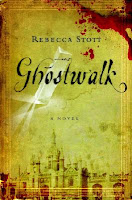
Ghostwalk: don't look behind you!

I know, I know, this is the wrong month for ghost stories, but this is the book selected by the teacher's book club for February. To appease those who insist on love stories for Valentine's Day, this is also a love story -- but not your ordinary kind. Writer Lydia Brooke agrees to complete the unfinished book after her ex-lover's mother dies unexpectedly. She moves into his mother Elizabeth's house and is soon enmeshed in research on the life and career of Sir Isaac Newton, the subject of the unfinished book. Sure enough, Lydia and the married Cameron soon resume their affair, but they both have many secrets. Cameron, a scientist who develops pharmaceuticals in a lab where they use rats for their trial experiments, is always in danger from an animal rights terrorist group -- but he doesn't tell Lydia about the true purpose of the drugs he's developing, nor of his involvement with a world-wide group pulling the strings. Lydia, conducting research on Trinity at Cambridge University in the 17th century, doesn't share information about the mysterious lights that appear in his mother's house, the odd disappearances, the man in a red cape she keeps seeing just out of the corner of her eye, nor the woman who approaches her to channel the spirits of contemporaries of Newton who died in unexplained ways.
The story takes meandering paths and leads Lydia into dangers she can neither foresee nor avoid. This is a book full of historical facts and scientific explanations -- but always with that surreal twist. Do you believe? This books makes it seem so possible that by the end you're not sure which explanation to believe -- the scientific or the supernatural.
I liked it okay, but it wasn't a totally-awesome thriller.
I'll give it three stars out of four.

Monday, January 12, 2009

Chilling yet Possible?

After reading a couple of "have-to" books, I was hungry (get it?) for a just-for-fun good book. The Hunger Games, by Suzanne Collins, fit the bill perfectly. It encompassed a cautionary tale along with a romance, adventure, a suspenseful conflict, and plenty to think about along the way.
The story takes place in a country that used to be the United States, which is now divided into twelve "districts" ruled by the Capitol. In punishment for the attempted rebellion of the twelve districts, the Capitol enforces an annual "Survivor"-like competition in which a boy and girl representative from each distrist must meet and fight to the death. 17-year-old Katniss is a hunter, responsible for putting food on her family's table since her father's death in the coal mines six years ago. Two names are drawn from a large ball to determine the district's representatives, and when Katniss' 12-year-old sister's name is drawn, Katniss rushes forward to volunteer in her place. Peeta, the son of a baker whom Katniss knew from school -- and also from an incident when he saved her from starving -- is the designated boy. They are whisked off to the Capitol to prepare for the Games. Soon the 24 competitors are locked into the "arena," which this year includes a forest with a stream, a lake, a grassland, and a large open meadow. All her life Katniss has been forced to watch the Games, and she knows some of the strategies that have helped former competitors survive. But she, and all the competitors, are at the mercy of the all-seeing Capitol, which has cameras stashed everywhere, and which can manipulate the weather inside the arena, can introduce natural disasters, predatory creatures, and other things to force the competitors to come together for battle -- for the sheer entertainment of the "viewers at home." I really got into this story, and saw many parallels with today's reality TV "entertainment." The environmental situation which brought the country to the conditions described in Hunger Games are reflected in almost every disastrous prediction you read in today's paper. So -- this COULD happen. And what would you or I do to survive, if this all came to pass?
I highly recommend this book, and give it 4 out of 4 stars!

Tuesday, December 16, 2008

Favorite Book of 2008 -- what's yours?


Mrs. Duell challenged all the RB teachers to identify their favorite book that they read this past year (don't you just love all the end-of-the-year Best-Of lists?) Believe it or not, I have kept track of all the books I've read this year (and the movies and plays I've seen -- what a nerd, right?) But that list is at home. Nevertheless, it took me only a moment to think of my favorite. The Thirteenth Tale, by Diane Setterfield, was at the very top of a long list of great books that I met this past year. It had suspense, drama, well-developed interesting characters, humor, pathos, and a satisfying ending. It was very well written, which captured my admiration -- it's fun to observe how an author structured a book, and to be still surprised by wonderful turns of phrase, delightful word choices, gorgeous passages... So - what it's about - - - Margaret Lea works at her father's rare book shop and hides the pain of her knowledge that her conjoined twin sister died on the day they were born, in the very operation that saved Margaret's life. After she wrote a biography that reveals her understanding of sibling (and specifically twin) relationships, she was contacted by reclusive author Vida Winter to write her biography. Miss Winter has spent a lifetime telling various biographers varying fantastic stories - but she vows that THIS time she'll tell the truth. Margaret combines interviews of Miss Winter with independent investigations. Vida tells about the once-proud Angelfield family from Yorkshire, who lived in an estate now fallen to ruins. There was eccentric and seductive Isabelle, her sadistic brother Charlie, and Isabella’s oddly disturbing twin daughters Adeline and Emmeline. A governess, a doctor, a few devoted servants, an abandoned baby, and a streak of madness and murder run through Angelfield. What do these characters have to do with Vida Winter? Finding out will keep you pasted to the pages of this wonderful novel. Grab it for a cold winter's day -- or couple of days. I guarantee you won't be able to put it down.
4 out of 4 stars

Monday, November 24, 2008

Suspense -- and empathy, too, in this book


Ms. Hayes' freshman English classes have been reading Stuck in Neutral, by Terry Trueman, so I decided to read it, too -- it's been on my "to-read list" for quite a while. It was a fast read, and a real page turner. Shawn is a 14-year-old boy who has cerebral palsy, and therefore has no control over his muscles. We the readers are able to hear his thoughts, and he sounds like any other kid his age, though he is very honest about his abilities and disabilities, his desires and wishes, and his relationships or lack thereof. Shawn can't speak, feed himself, control his bowels, stand, or let anyone know his thoughts. His parents have been divorced for years. Shawn, his brother, and sister live with their mom, and Dad is not too far away. He had written a Pulitzer-Prize winning poem about Shawn years ago that won him a lot of acclaim, and now he is appearing on TV to suggest that too much money is spent to "educate the uneducable" -- and he features an imprisoned man found guilty of murder after he killed his brain-damaged 2-year-old son. Shawn comes to suspect that his father plans to kill HIM, too. And if that IS his dad's intention, Shawn knows he can't do anything to stop it.

This was an enlightening book which made me really think. I found it especially moving that the author has a son much like Shawn - and he must have wondered whether his son has deep thoughts, whether he knows things and is aware of his world as Shawn is. That thought is both sad and hopeful. I highly recommend this book -- and can't wait to read its partner-book, Cruise Control, told from the point of view of Shawn's brother Paul.

Sunday, November 16, 2008

Omnivore's Dilemma


My son has been telling me facts from this book for months. I've heard rumblings in various conversations, read in assorted news reports, and have been on the periphery of understanding many "background secrets" of how our diets or overly dependent on Almighty Corn. Well, as a former Iowan, and as a descendant of many Illinois farmers, the chapters on corn and the changes in farming over the past 25 years was fascinating. How agribusiness has changed the planting cycle, the use of the land, the use of pesticides, the way livestock is raised, fed, and butchered -- it all was very depressing and yet, viewed logically, understandable from a purely business perspective. Nutritionally, ethically, and possible-doomsday-apocalyptic-worldly, it is easy to buy into Pollan's view that the changes we have wrought may come back to bite us in the ____. Feed us now, starve us later. . .
This is an important book. But somewhat overwhelming in what it calls for us to change in our daily lives. And leads to the view that "though I may change my own little piece, what possible difference will that make in the world as a whole?" But then, an awareness of global climate change has brought about all sorts of movements and changes -- so maybe we can also bring the world back into harmony agriculturally and food-wise, too. If you haven't read this book, check out at least the first section on corn. I hear the second section, on organic gardening/farming, is also good, so I intend to keep plugging away.
Rating so far: 3 out of 4 stars.

TH1RTEEN R3ASONS WHY


LONG time, no update! Since October, I have finally finished reading The Story of Edgar Sawtelle by David Wroblewski. It's a LONG book. Very interesting, very descriptive, intriguing characters, and a lot about animal training and about dog behavior (and dog mental states -- does that sound weird?). I was into the story, wishing it were a little better edited (it's so LONG -- did I mention that?), but still hanging in there. And when I got to the ending, I tried to figure out why that ending was necessary. Did it resolve a character, or a theme, or did the author just not have any other ideas of what could happen next? It was totally an Oprah book ending, and I was a combination of disgusted, disappointed, and depressed. Why invest that much time in a book to end it with no hope, no uplifting message, no real resolution for the problems that the characters had wrestled with throughout the book??? Why, why, why?
Rating: 2 out of 4 stars. Some good phraseology, but yuk on the construction of the story/and the ending.

Anyway, as you can see from the image posted above, I just read another book -- Thirteen Reasons Why, by Jay Asher. It was a pretty quick read -- well, if you decide to do without sleep, read during an entire three-hour car ride, and ignore people around you, which was my process. The premise is that Clay receives a box with no return address which contains several numbered audiotapes. When he begins to listen, he hears the voice of a girl from his school, Hannah, who had committed suicide a short time before. He hears that he has received the tapes because he is one of thirteen people who needs to hear why she killed herself, and he may be one of those reasons. What follows is an agonizing step-by-step journey through some painful interactions she, Hannah, had with other people, and we, the witnesses to her story, are forced to acknowledge that what we say and do really DOES make a difference -- sometimes in ways we can't foresee or imagine. I usually cringe if a book is too melodramatic (my objection to the Twilight series,) but this one gets a pass because the emotion is too real and raw. This book provides a lot of ideas to think about, and would be a good one to discuss with others. If somebody else reads this, please seek me out so we can chat.
Rating: 4 out of 4 stars